Top Galvalume Corrugated Sheet Suppliers Worldwide
Choosing reliable Galvalume Corrugated Sheet suppliers requires more than comparing online prices. This guide examines manufacturers and distributors serving construction markets worldwide. It focuses on practical evidence, not polished claims. We consider coating composition, base steel grade, sheet thickness, profile depth, width, and tolerance control. These details affect roof strength, water management, and installation speed. Experienced buyers also check AZ coating weight, paint systems, edge quality, and packaging. A sheet may look bright under warehouse lights, yet hidden scratches can invite early corrosion. Supplier history matters. So do responsive technical support and consistent production records. Samples help, but they cannot replace factory audits or independent testing. That distinction is often missed.
The suppliers discussed here are assessed through documented specifications, quality certificates, production capabilities, export experience, and customer-focused communication. Relevant standards may include ASTM, EN, JIS, or project-specific requirements. Buyers should verify current certificates directly with issuing bodies whenever possible. Lead time deserves equal attention. Port congestion, coil availability, and local forming capacity can change delivery plans quickly. We also compare minimum order quantities, warranty terms, customization options, and after-sales support. No ranking remains perfect for every market. A contractor in humid coastal Brazil needs different assurances from a warehouse builder in dry inland Australia. Price is only one part of value. This overview supports careful shortlisting while encouraging technical verification before contracts are signed. Some supplier information changes faster than published pages suggest. Check again.
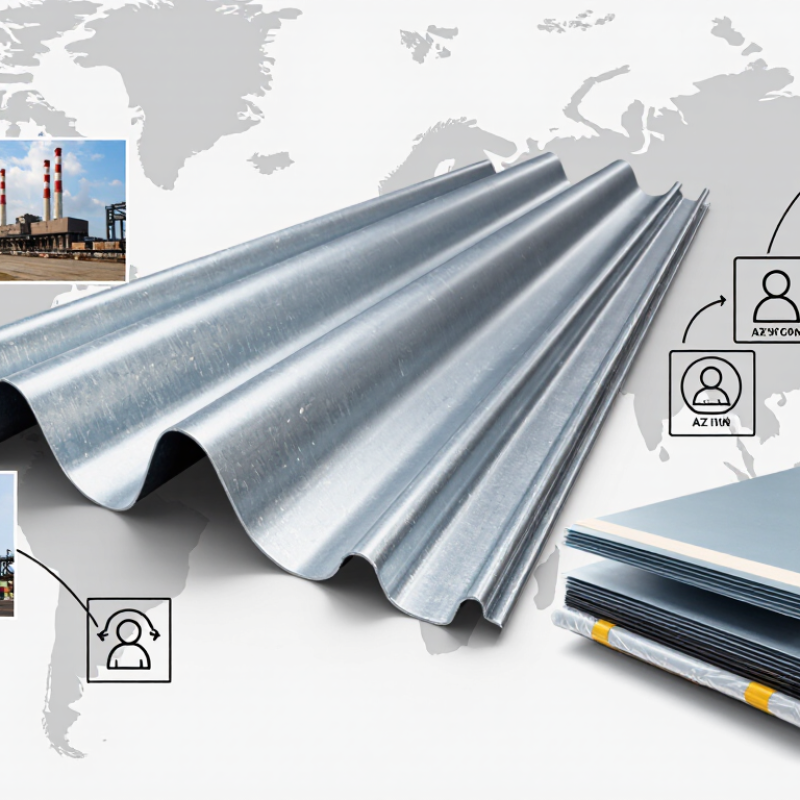
Galvalume Composition: 55% Aluminum, 43.4% Zinc, and 1.6% Silicon
Top galvalume corrugated sheet suppliers worldwide should explain more than coating thickness and price. The coating typically contains 55% aluminum, 43.4% zinc, and 1.6% silicon by mass. This balance is deliberate. Aluminum forms a durable barrier, while zinc helps protect exposed edges and small scratches. Silicon improves coating control during manufacturing and supports consistent adhesion to the steel substrate. This chemistry gives the sheet strong resistance to heat, moisture, and atmospheric corrosion. Still, performance depends on forming quality, cut-edge treatment, profile design, and local exposure.
Experienced buyers should request mill certificates, coating mass data, steel grade, and dimensional tolerances. Inspect the surface under angled light. Look for bare spots, uneven spangles, deep scratches, or oil residue. Samples should be bent using the project’s specified radius, not an improvised workshop method. Suppliers should also explain packaging, storage, and delivery protection for humid routes. I have seen attractive sheets fail early when stacked wet after arrival. That lesson is easy to overlook.
Tips: Compare composition and coating mass together. Do not judge quality by shine alone. Confirm whether the stated percentages describe the coating, not the entire sheet. Ask for recent test records and a small trial order.
Top Galvalume Corrugated Sheet Suppliers Worldwide - Galvalume Composition: 55% Aluminum, 43.4% Zinc, and 1.6% Silicon
| Supply Market / Region | Common Product Form | Typical Thickness | Typical Effective Width | Common Coating Mass | Frequently Referenced Standard | Typical Applications |
| East Asia | Corrugated roofing and wall panels | 0.30–1.20 mm | Approximately 750–1,100 mm | AZ50–AZ150, depending on specification | ASTM A792/A792M or equivalent | Residential roofing, industrial buildings, warehouses |
| South Asia | Exposed-fastener roofing sheets | 0.35–1.00 mm | Approximately 800–1,050 mm | AZ70–AZ150 | ASTM A792/A792M or EN 10346 | Low-rise construction, agricultural buildings, canopies |
| Southeast Asia | Roofing sheets and prepainted panels | 0.35–0.80 mm | Approximately 750–1,000 mm | AZ50–AZ150 | EN 10346 or ASTM A792/A792M | Tropical residential, commercial, and agricultural structures |
| Europe | Cold-formed roofing and façade profiles | 0.40–1.00 mm | Profile-dependent; commonly 700–1,100 mm | Approximately 100–185 g/m² | EN 10346 | Building envelopes, façades, roofing systems |
| North America | Agricultural, commercial, and architectural panels | Approximately 0.43–1.20 mm | Profile-dependent; commonly 700–1,100 mm | AZ50–AZ180 | ASTM A792/A792M | Metal roofing, siding, industrial and agricultural buildings |
| Latin America | Corrugated roofing and lightweight cladding | 0.35–0.90 mm | Approximately 750–1,050 mm | AZ70–AZ150 | ASTM A792/A792M or local equivalent | Housing, workshops, retail buildings, and rural structures |
| Middle East and Africa | High-reflectance roofing and wall cladding | 0.40–1.00 mm | Approximately 750–1,100 mm | AZ70–AZ150 | ASTM A792/A792M or EN 10346 | Warehouses, logistics facilities, shaded structures, roofing |
| Material composition: 55% aluminum, 43.4% zinc, and 1.6% silicon by coating bath composition. Actual product chemistry, coating mass, dimensions, tolerances, and mechanical properties should be confirmed against the applicable mill test certificate and purchasing specification. |
Global Supplier Regions and Production Capacity for Corrugated Galvalume Sheets
Global supplier regions for corrugated Galvalume sheets follow major steel and construction markets. Asia remains the largest supply base, supported by extensive coating lines, strong export networks, and nearby appliance and building industries. World Steel Association data reports that China produced about 1.01 billion tonnes of crude steel in 2024, while India produced approximately 149 million tonnes. These figures indicate strong upstream capacity, but they do not represent Galvalume sheet output directly.
The regional picture is broader. Southeast Asian mills increasingly serve roofing and industrial projects, while North American suppliers benefit from mature continuous coating technology and established construction demand. European producers generally focus on specification control, energy efficiency, and shorter regional delivery routes. OECD steel reports continue to highlight global overcapacity concerns, making nominal mill capacity less useful than verified production, coating width, and export availability.
Capacity is not the whole story. A plant may advertise large annual output, yet allocate only a small portion to corrugated Galvalume products. The International Energy Agency also identifies steelmaking emissions and energy intensity as major industry challenges. Buyers should request recent production records, coating mass certificates, thickness tolerances, and shipment data. These checks reveal practical reliability. The data remains imperfect. Public reports rarely separate corrugated Galvalume sheets from other coated steel products, so supplier comparisons should treat capacity estimates as informed indicators, not exact totals.
Top Galvalume Corrugated Sheet Suppliers by Standards, Grades, and Markets
Top Galvalume Corrugated Sheet Suppliers Worldwide
Global buyers should rank Galvalume corrugated sheet suppliers by standards, grades, and market capability. The World Steel Association reported 1.88 billion tonnes of crude steel production in 2024. That scale makes certification and supply consistency essential.
ASTM A792 commonly specifies a 55% aluminum, 43.4% zinc, and 1.6% silicon coating by mass. EN 10346 supports continuous hot-dip coated steel for European construction applications. AS 1397 and JIS G3321 address regional requirements in Australia and Japan.
Suppliers should provide coating mass, yield strength, tensile strength, thickness tolerance, and test results. Small differences matter. A 0.50-millimeter sheet can behave differently after forming, especially around sharp roof bends.
Commercial grades often include commercial quality, forming quality, and structural grades. Higher structural grades suit industrial roofing, warehouses, and agricultural buildings. Lighter forming grades work better for residential panels and rainwater profiles.
The International Energy Agency reported that buildings and construction remained major steel-consuming sectors in recent materials analysis. This supports careful market matching, not simple price comparison.
A supplier may hold valid certificates yet deliver inconsistent flatness or packaging. That is an uncomfortable risk. Buyers should inspect coil traceability, edge protection, salt-spray evidence, and container loading records before approving long-term supply.
Data sheets help, but physical samples reveal the truth.
ASTM A792, EN 10346, and ISO 9001 Requirements for Supplier Qualification
Top Galvalume Corrugated Sheet Suppliers Worldwide
Supplier qualification should begin with product standards, not attractive catalog photos. ASTM A792 defines requirements for aluminum-zinc coated steel sheet, including coating designation, steel grade, dimensions, and testing. EN 10346 covers continuously hot-dip coated flat steel products in European markets. These standards are related, but they are not interchangeable. Confirm the exact grade, coating mass, thickness tolerance, and corrugation profile stated in the purchase specification.
ISO 9001 certification evaluates a supplier’s quality management system. It does not automatically prove ASTM A792 or EN 10346 compliance. Request current certificates, mill test reports, coating test results, and batch traceability records. A reliable supplier should connect each coil number to production dates, raw material data, and inspection results. Ask how samples are handled. Good answers are specific. Vague answers deserve a second review. Even experienced buyers can overlook profile depth or effective cover width.
Tips: Compare test methods, not only numbers. Verify certificate validity with the issuing body. Inspect packaging, edge protection, and surface uniformity before shipment. Small rust marks or uneven coating can reveal storage problems. Keep approval samples and signed specifications. This makes disputes easier to examine. No process is perfect. A supplier may meet the standard yet still miss your forming requirements, so trial production remains valuable.
 Skip to content